Grate Buying Guide
7mm vs 9mm Grill Grates: The Honest Truth (That Most Sources Get Wrong)
Most buying guides treat 9mm stainless steel grill grates as automatically better than 7mm grates. The pit-master consensus from people who own BOTH disagrees: there's no notable difference in cooking quality. The real differences are heat retention (9mm holds heat better when the lid opens), sear marks (9mm produces more pronounced char lines), tighter spacing (9mm prevents food falling through), and price (7mm is $50-100 cheaper per set). For most home cooks, 7mm is fine. 9mm is worth the upgrade only if you specifically want premium sear marks for thick steaks OR cook regularly in cold weather where heat retention matters. This guide covers the actual evidence-based differences — not the marketing pitch.
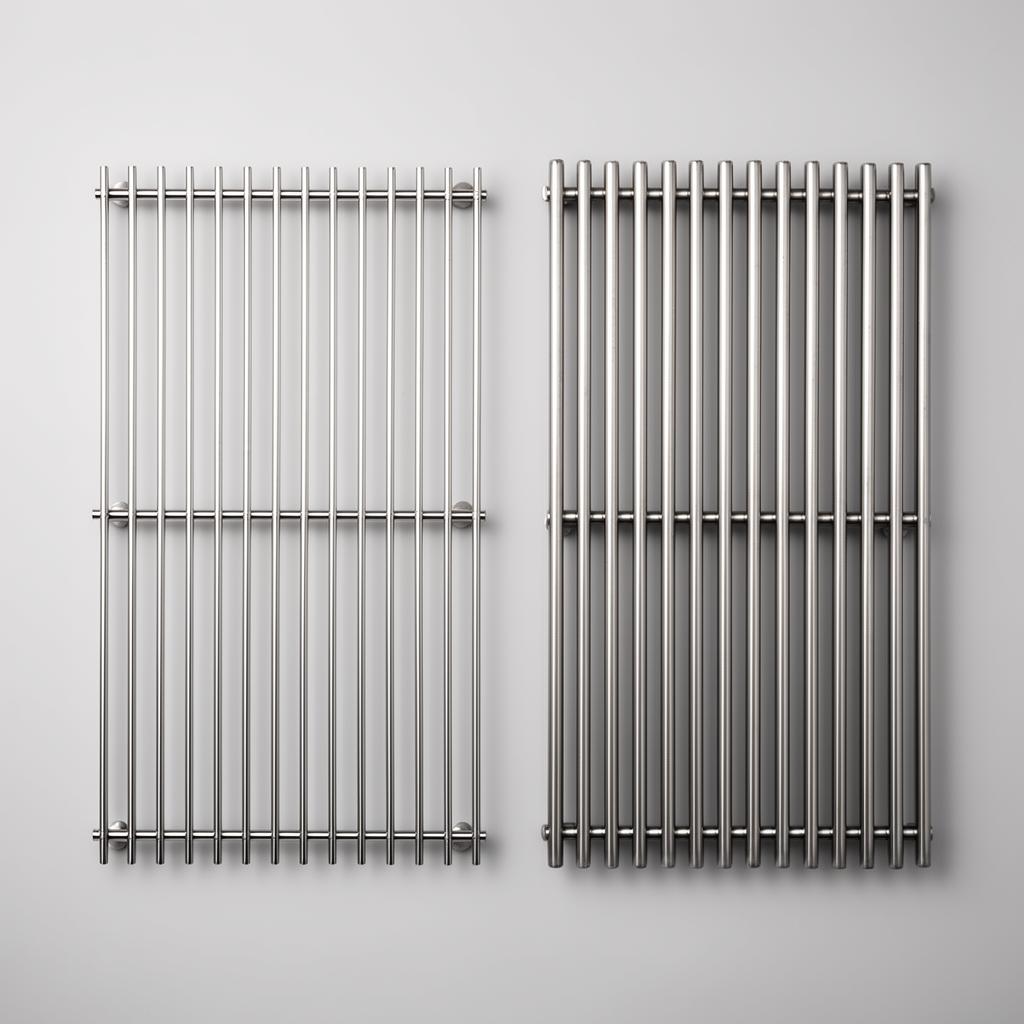
Pit-master consensus: cooking quality is identical. The real differences are price, heat retention, and sear marks.
The Short Answer
Our 60-Second Verdict
For 80% of buyers, 7mm grates are fine. Cooking quality is essentially identical between 7mm and 9mm — pit masters with both grates report "no notable difference in food quality." Save $50-100 per set with 7mm.
Buy 9mm if you specifically want premium sear marks (thicker rod = more pronounced char lines), cook regularly in cold weather (more mass = better heat retention), or want maximum 25+ year lifespan (9mm lasts ~20% longer than 7mm).
Skip 9mm if budget matters, you cook quickly in summer weather, or you don't care about Instagram-worthy sear marks. Both grates produce restaurant-quality cooking results — the difference is mostly subjective preference.
The "9mm is automatically better" claim is mostly marketing. Both are excellent. Pick based on your actual priorities, not on assumptions.
Share this recipe:
The Basics
What Does "7mm" or "9mm" Actually Mean?
The numbers refer to the diameter of the stainless steel rods that make up the grate. Two thicknesses dominate the market.
Modern stainless steel grill grates are constructed from solid stainless steel rods welded into a grid pattern. The "7mm" or "9mm" specification refers to the diameter of those rods — about 1/4 inch vs 3/8 inch.
7mm Grates (~1/4 inch)
Standard thickness for most current Weber gas grills (Spirit II, Genesis II E-models, Q-series). Solid stainless steel construction. Total grate weight: ~10-12 lbs for a typical Spirit/Genesis grate set. Heats up faster than 9mm. Spacing between rods slightly wider. Cost: ~$80-130 OEM, $50-90 aftermarket. Lifespan: 15-20+ years with normal use.
9mm Grates (~3/8 inch)
Premium thickness historically reserved for Weber Summit and pre-2007 Genesis. Now widely available aftermarket for most Weber models from QuliMetal, Hongso, RCPlaneBuyer. Total grate weight: ~16-23 lbs for a typical grate set (50-70% heavier than 7mm). Holds heat longer. Tighter spacing. Cost: ~$130-200 OEM, $80-150 aftermarket. Lifespan: 20-25+ years.
Other Variants (Worth Knowing)
9.5mm grates exist (slightly thicker than standard 9mm) — mostly aftermarket for Genesis II 300 Series. 11mm grates are rare premium aftermarket for buyers wanting maximum mass. Porcelain-coated rods are different category entirely (chip over time, not the same material discussion). This guide focuses on solid stainless 7mm vs 9mm — the two dominant options.
Important context: Both 7mm and 9mm stainless grates are made from 304 stainless steel (the food-grade standard). Material quality is identical. Only the thickness differs. So the comparison is purely about how rod thickness affects cooking — not about steel grade or quality.
The Real Tradeoffs
The 4 Differences That Actually Matter
Most buying guides oversimplify this. Here's the evidence-based breakdown of where 9mm actually wins, where 7mm wins, and where they tie.
1. Heat Retention When Lid Opens
Every time you open the grill lid, hot air escapes and the grates lose temperature. The recovery time depends on how much heat the grates retained. Thicker rods = more thermal mass = better retention.
Real-world impact: 9mm grates recover temperature ~30 seconds faster after lid opening compared to 7mm. Over a typical cook with 5-8 lid openings, this saves 2-4 minutes of total cook time. Meaningful for cold-weather cooking (where heat loss compounds), less impactful in summer.
Verdict: 9mm wins. Real difference, but moderate (not dramatic).
2. Sear Marks (the "Char Line" Look)
Sear marks come from direct contact between the grate rod and the meat surface. Hotter rods + wider contact area = more pronounced sear marks. 9mm rods produce wider char lines (about 3/8 inch wide) vs 7mm rods (about 1/4 inch wide).
Real-world impact: 9mm produces noticeably wider sear marks in photos and on the plate. This is a visual/aesthetic difference, not a flavor difference — both grates produce plenty of Maillard browning. If you photograph your steaks for Instagram or want restaurant-style char patterns, 9mm wins. If you don't care about visual presentation, 7mm produces equally delicious food.
Verdict: 9mm wins for visual presentation. Tie for actual flavor.
3. Rod Spacing (Food Falling Through)
The space between rods determines whether small food items can fall through to the burners. Tighter spacing = less food loss. 9mm grates often (but not always) feature tighter spacing because manufacturers use the extra material budget to add more rods per inch.
Real-world impact: Mostly affects shrimp, sliced vegetables, asparagus, and small items. For burgers, steaks, chicken pieces, ribs — neither thickness matters. If you grill lots of small items, 9mm's tighter spacing is meaningful. For typical proteins, indistinguishable.
Verdict: 9mm wins for small-item grilling. Tie for typical proteins.
4. Heat-Up Time (Time to Reach Cooking Temperature)
The grate needs to reach cooking temperature before food touches it. More mass = longer heat-up time. 9mm grates take ~2-3 minutes longer to fully preheat compared to 7mm.
Real-world impact: 7mm grates fully preheat in 8-10 minutes; 9mm in 10-13 minutes. For weeknight quick cooks, 7mm is meaningfully faster. For weekend low-and-slow cooks, the difference is negligible. If you're a weeknight griller who values speed, 7mm has a small advantage.
Verdict: 7mm wins by small margin. Most cooks won't notice.
The honest summary: 9mm wins on heat retention and sear marks (for those who care). 7mm wins on heat-up time and price. Cooking quality is essentially identical. For most cooks, 7mm is fine. For specific use cases (premium sear marks, cold-weather cooking), 9mm is worth the upgrade.
At a Glance
7mm vs 9mm Side-by-Side
Quick reference table for buyers cross-shopping replacement grates.
Standard Choice
7mm Grates
- Rod diameter: ~1/4 inch
- Total weight: 10-12 lbs typical set
- Heat retention: Good
- Sear mark width: ~1/4 inch
- Heat-up time: 8-10 minutes
- Spacing: Standard (some food falls through)
- OEM price: $80-130 per set
- Aftermarket price: $50-90 per set
- Lifespan: 15-20+ years
- Best for: Most home cooks, budget-conscious buyers, weeknight grillers
Premium Upgrade
9mm Grates
- Rod diameter: ~3/8 inch
- Total weight: 16-23 lbs typical set
- Heat retention: Excellent (30+ sec faster recovery after lid opens)
- Sear mark width: ~3/8 inch (more pronounced)
- Heat-up time: 10-13 minutes
- Spacing: Often tighter (less food falls through)
- OEM price: $130-200 per set
- Aftermarket price: $80-150 per set
- Lifespan: 20-25+ years
- Best for: Steak enthusiasts, cold-weather cookers, "buy once" mentality
The price difference is meaningful: $50-100 per set. For most cooks, 7mm produces equivalent results at lower cost. For specific use cases (premium sear marks, cold-weather cooking, multi-decade ownership), 9mm is worth the upgrade. Neither is "wrong" — just different tradeoffs.
Which Weber Has Which?
Weber Models by Grate Thickness
If you own a Weber, you might already have 9mm grates without knowing it. Reference list of which models come with which.
Models with 9mm Grates (factory)
- • Older Genesis (pre-2007): Silver, Gold, Platinum models
- • All Weber Summit models (Summit S-470, S-670, etc.) — Summit's signature
- • Some premium S-variants (stainless models often had 9mm)
- • Some Genesis EP models (Premium Plus variants)
Identification: If your Weber is a Summit OR pre-2007 Genesis Silver/Gold/Platinum/EP, you likely have 9mm. Lift one grate — should weigh 5-7 lbs (single grate). 7mm grates weigh 3-5 lbs single grate.
Models with 7mm Grates (factory)
- • Current Spirit (E-310, E-315, E-325, S-310, S-325)
- • Current Genesis II (E-310, E-315, E-330, E-335, S-310, S-335)
- • Genesis II LX (E-340, S-340)
- • Most post-2007 Genesis E-models (porcelain coating + 7mm stainless)
- • Q-series (Q1200, Q2200) — porcelain-coated cast iron, not stainless
Identification: If your Weber is current production (2017+) and labeled "E-" model, you likely have 7mm. Most Weber gas grills sold today fall into this category.
Important note for current Weber owners: If you have 7mm grates and want to upgrade to 9mm aftermarket, the 9mm grates from QuliMetal, Hongso, or RCPlaneBuyer are the standard upgrade path. Costs $80-150 per set vs Weber OEM 9mm at $150-200. Quality is generally equivalent for 304 stainless aftermarket.
Should You Upgrade?
4 Scenarios Where Upgrading from 7mm to 9mm Makes Sense
Upgrading aftermarket isn't free — 9mm grates cost $80-150 per set. Here's when the upgrade is worth it.
You're a Steak Enthusiast
If you regularly cook thick steaks (1.5"+ ribeye, NY strip, prime rib slices) and care about Instagram-worthy crosshatch sear marks, 9mm wins. The wider char lines are visually distinctive. Don't upgrade if you mostly cook burgers, chicken, or sausages — 7mm produces equally delicious results.
You Cook in Cold Weather
Northern climates (Canada, Northern US, mountain regions) benefit from 9mm's heat retention. Cold air outside the grill steals heat through every lid opening. 9mm's extra mass restores temperature 30+ seconds faster. Over a typical cook in 30°F weather, this saves 5-10 minutes of total cook time. For year-round Southern cooks, the difference is negligible.
You're Replacing Worn Grates Anyway
If your existing grates are reaching end-of-life (rust, warping, broken welds), the replacement decision is forced. At that point, the 9mm upgrade costs only $30-60 more than 7mm replacements. For "buy once for the rest of grill's life" mentality, 9mm makes sense at this inflection point.
You Have a Multi-Decade Mentality
If you plan to keep your grill 20+ years (Weber grills genuinely last this long), 9mm's longer lifespan (25+ years vs 7mm's 15-20) means you might never replace them again. Compounded over 25 years of ownership, the upgrade cost is meaningful. For grillers planning 10-15 year ownership, 7mm produces equivalent results.
When to skip the upgrade: budget-conscious cooks, weeknight grillers who value heat-up speed, owners who don't care about Instagram-worthy sear marks, Southern climate cooks. For these scenarios, 7mm produces equivalent cooking results with no meaningful tradeoffs.
Shopping Guide
Where to Buy 7mm and 9mm Grill Grates
Three primary sources for replacement grates with different tradeoffs.
Weber OEM (weber.com)
Genuine Weber grates direct from manufacturer. Premium pricing ($130-200 for 9mm sets, $80-130 for 7mm sets). Guaranteed perfect fit. 5-year warranty. Slow shipping. Best for: warranty replacements, perfect-fit buyers, Weber loyalists.
Best models: Weber 7637 (7mm Genesis), Weber 7528 (Genesis 300 series 9mm)
Shop Weber OEM gratesAftermarket (QuliMetal, Hongso)
Quality 304 stainless aftermarket from QuliMetal, Hongso, Stanbroil. Significant savings ($80-150 for 9mm vs Weber's $150-200). 304 stainless quality matches Weber OEM. Wide availability. Best for: budget-conscious buyers, fast Amazon shipping, multiple Weber models supported.
Best brands: QuliMetal, Hongso, Stanbroil, GFTIME
Shop aftermarket gratesSpecialty (RCPlaneBuyer, BBQparts)
Specialty makers like RCPlaneBuyer (Dave Santana) and BBQparts.com produce ultra-heavy-duty grates often exceeding 9mm specifications. Premium pricing matching or exceeding Weber OEM. Best for: enthusiasts wanting maximum mass, vintage Weber restorers, "lifetime" buyers.
Best for: Vintage Weber rehabs, premium aftermarket
Shop specialty gratesOur typical recommendation: For 80% of buyers, aftermarket 9mm from QuliMetal or Hongso ($80-150) delivers genuine premium quality at accessible prices. Buy Weber OEM only for warranty replacements or extreme Weber loyalists. Specialty makers (RCPlaneBuyer) are for buyers specifically wanting maximum mass for "lifetime" ownership.
Myths to Avoid
5 Common 7mm vs 9mm Misconceptions
Five claims you'll see in lower-quality buying guides that aren't actually true.
Myth 1: "9mm cooks better than 7mm"
FALSE. Pit masters with both grates report identical food quality. The cooking is determined by your grill's BTU output, burner design, and your technique — not by rod thickness. Both grates produce restaurant-quality results when used correctly.
Myth 2: "9mm rusts less than 7mm"
FALSE. Both 7mm and 9mm grates are 304 stainless steel — same rust resistance. Thickness affects mass, not corrosion resistance. Either thickness will rust if neglected; either will last decades with basic maintenance.
Myth 3: "All 9mm grates are equivalent"
FALSE. Different aftermarket brands (RCPlaneBuyer vs BBQparts.com vs QuliMetal) actually use slightly different rod diameters labeled "9mm." RCPlaneBuyer is genuinely 9mm+ (some report 10mm); BBQparts.com is closer to 8mm. Read product descriptions carefully — exact diameter varies.
Myth 4: "7mm is for cheap grills only"
MOSTLY FALSE. Current Weber Genesis II 300 Series and Genesis II LX (premium-tier $1,500-2,500 grills) all ship with 7mm stainless. Modern Weber engineers chose 7mm for these premium models — not because of cost-cutting, but because the BTU output of newer Genesis grills works better with thinner grates that heat up faster.
Myth 5: "You need 9mm for serious cooking"
FALSE. Multiple Weber Summit owners and Genesis owners with 7mm have produced championship-level BBQ results. The grate thickness is one variable in cooking quality — far more important variables include BTU output, two-zone setup, meat selection, and timing. 7mm doesn't limit serious cooking; it just produces slightly different sear marks.
FAQ