Brand Comparison

Weber vs Traeger: The Honest Category-by-Category Comparison

"Weber vs Traeger" is usually framed as a simple either-or question, but the honest answer depends entirely on what you're cooking. Weber has dominated gas grills since the 1950s and charcoal kettles since 1952 — they own both categories, and Traeger doesn't meaningfully compete. Traeger invented the pellet grill in 1986 and still has the most mature pellet grill ecosystem, though Weber's Searwood (launched 2024) is genuinely competitive. The right answer for most serious backyard cooks: Weber for gas and charcoal, Traeger for pellet grills, and some households benefit from owning both. This comparison covers the honest category-by-category truth so you can match the right brand to your actual cooking priorities.

13 min readUpdated April 2026Four-category analysis
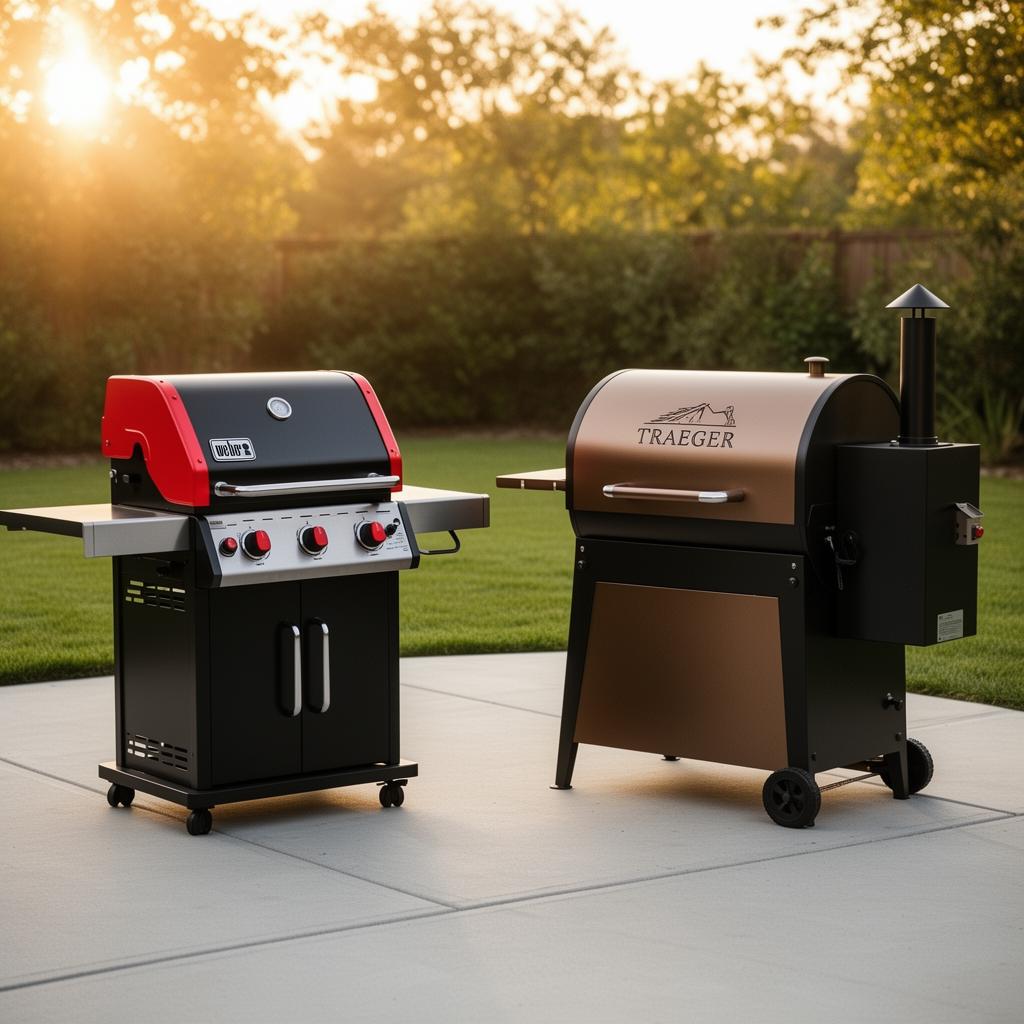
Weber gas grill and Traeger pellet grill comparison on backyard patio

Weber for gas and charcoal. Traeger for pellets. Both are excellent — the question is which cook type you prioritize.

The Short Answer

The 60-Second Verdict

For gas grills and charcoal grills, buy Weber. The Spirit, Genesis, Summit, and Master-Touch lines dominate their categories with 70+ years of refinement and the best grill warranty coverage in the industry. Traeger doesn't meaningfully compete in either category.

For pellet grills, Traeger is the safer default, but Weber's Searwood (launched 2024) has closed the gap and beats Traeger at high-heat searing. Traeger still wins on app ecosystem, broader model range, and mature accessory support. If you prioritize pellet grilling specifically, Traeger's Woodridge Pro is the right default pick unless you specifically want Weber's Searwood searing advantage.

For serious backyard cooks, owning a Weber (for gas or charcoal) AND a Traeger (for pellet smoking) often delivers the best total outcome — each brand optimized for what they do best.

Category Breakdown

Weber vs Traeger: Category-by-Category Truth

Most comparisons treat this as one brand-vs-brand question. The honest answer requires looking at each product category separately.

Weber Wins

Gas Grills

Winner: Weber (decisive)

Weber manufactures 4 gas grill lines spanning entry-tier ($449 Spirit II) to premium ($1,499+ Summit). 70+ years of gas grill engineering. Broad retail availability. 10-year warranty on cookbox, lid, burner tubes, flavorizer bars, and grates. Traeger doesn't make traditional gas grills. Their hybrid "Flatrock" is a griddle, not a gas grill competitor.

See our Weber Spirit E-215 review

Weber Wins (Decisively)

Charcoal Grills

Winner: Weber (Traeger doesn't make them)

Weber invented the kettle grill in 1952 with the Original Kettle. Current lineup spans Master-Touch 22" ($289), Master-Touch 26" ($399), Performer Premium ($399), Summit Kamado ($1,149+), and the Weber Smokey Mountain bullet smoker ($349-599). Traeger doesn't make charcoal grills at all. If you want charcoal flavor, Weber is the only meaningful choice.

See our 22" Master-Touch review

Traeger Wins (Barely)

Pellet Grills

Winner: Traeger (Weber Searwood closing the gap)

Traeger invented the pellet grill in 1986. Current lineup: Ranger, Woodridge Base/Pro/Elite, Ironwood, Timberline. Mature app ecosystem, WiFIRE technology, broader accessory support, best-in-class recipe library. Weber's Searwood (launched 2024) is competitive — better at high-heat searing, 600°F capability. But Traeger has deeper pellet-specialization experience.

See our Traeger Pro comparison

Roughly Even

Portable Grills

Winner: Depends on fuel type preference

Weber: Q-series (propane gas), Smokey Joe (charcoal), Traveler (full-size portable gas). Best portable gas grills on the market. Traeger: Ranger (pellet, requires power source). Specialized for pellet fans on the go.

See our Weber Q1200 review

The "Weber vs Traeger" decision depends entirely on what you want to cook. Gas grill shoppers: Weber by default. Charcoal shoppers: Weber (Traeger doesn't compete). Pellet grill shoppers: Traeger is the safer pick, though Weber Searwood deserves consideration for sear-focused cooks. Portable grill shoppers: match the brand to your fuel type preference.

The Pellet Grill Deep Dive

Weber Searwood vs Traeger Woodridge: The Real Pellet Grill Comparison

When people ask "Weber vs Traeger," most are actually asking about pellet grills — the only category where both brands compete directly. Here's the honest comparison of the current competitive pellet grill models.

Traeger Flagship

Traeger Woodridge Pro

$999

  • • 970 sq in cooking area
  • • 165–500°F temperature range
  • • WiFIRE app + Super Smoke Mode
  • • Digital pellet sensor
  • • Keep Warm Mode
  • • D2 drivetrain (proven)
  • • 3-year warranty

Strengths

  • Best-in-class pellet grill app (WiFIRE)
  • Mature accessory ecosystem (decades of development)
  • 1,000+ recipes in the Traeger app
  • Pellet grilling is Traeger's specialty — they invented this

Weaknesses

  • 500°F max temp limits searing capability
  • No direct flame access for high-heat grilling
  • Shorter warranty than Weber (3 years vs 10)
Shop Woodridge Pro
Weber Pellet

Weber Searwood 600

$999

  • • 600 sq in cooking area
  • • 180–600°F temperature range (+100°F over Traeger)
  • • Weber Connect app + SmokeBoost mode
  • • Flavorizer bars (borrowed from Weber gas grills)
  • • Stainless steel grates
  • • 5-year warranty (better than Traeger)

Strengths

  • 600°F max temp genuinely sears steaks
  • Flavorizer bar design enhances smoke flavor
  • Weber Crafted accessory system compatibility
  • 5-year warranty vs Traeger's 3-year

Weaknesses

  • Smaller cooking area than Woodridge Pro (600 vs 970 sq in)
  • Weber Connect app less polished than Traeger's WiFIRE
  • Newer to pellet grilling (launched 2024 vs Traeger's 1986)
  • Fewer aftermarket accessories than Traeger ecosystem
Shop Weber Searwood

The Searwood closed the Weber-Traeger pellet gap meaningfully. For high-heat searing and Weber loyalists, the Searwood is the right pick. For maximum cooking capacity, smoother app experience, and deepest accessory ecosystem, the Woodridge Pro is still the safer default. At the same $999 price, both are genuine recommendations.

Weber Advantages

What Weber Does Best

Weber's brand strengths extend beyond individual products to the overall ownership experience.

10-Year Warranty (Industry-Leading)

Weber offers 10-year warranty coverage on major components (cookbox, lid, burners, flavorizer bars, cooking grates) across virtually every grill they make. Traeger typically offers 3-year coverage. Over 15-20 years of ownership, this difference is meaningful — Weber grills cover their major components until year 10, while Traeger owners are on their own by year 4.

Retail Ubiquity

Weber is carried at Home Depot, Lowe's, Ace Hardware, Walmart, Amazon, Costco, and specialty grill stores. You can walk into virtually any home improvement store and buy a Weber today. Traeger has similar-but-narrower retail presence. Weber's availability is essentially universal in the US market.

70+ Year Brand Reputation

Weber has been making grills since 1952 (kettle) and 1985 (Genesis gas). Traeger is 38 years old as a brand (founded 1986). Weber's brand equity is substantial — resale values are higher, owner loyalty is stronger, and parts/accessories are easier to find for even 30-year-old Weber grills. Brand heritage matters for long-term ownership value.

Parts Ecosystem

Weber OEM and aftermarket parts are widely available — Weber.com, Amazon, Home Depot, specialty sellers (QuliMetal, Hongso, Uniflasy). Even 20-year-old Weber grills can be repaired inexpensively. Traeger parts ecosystem is good but narrower, especially for discontinued models. Weber's parts availability is genuinely advantageous for long-term ownership.

Traeger Advantages

What Traeger Does Best

Traeger's brand strengths center on pellet grill specialization and app ecosystem polish.

Pellet Grilling Specialization

Traeger invented the pellet grill in 1986 and has 38 years of refinement. Every Traeger product is designed around pellet grilling — D2 drivetrain, WiFIRE, Super Smoke Mode, pellet sensors. Weber's pellet grills are competent but newer. If pellet grilling is your priority, Traeger's specialization advantage is real.

Best-in-Class App (WiFIRE)

The Traeger app is widely regarded as the best pellet grill app on the market. 1,000+ recipes, guided cooks with step-by-step instructions, temperature monitoring, cook logs, and smart home integration. Weber's Weber Connect app works but is less polished. If you plan to use smartphone monitoring extensively, Traeger wins.

Mature Pellet Accessory Ecosystem

Traeger pellets, Traeger rubs, Traeger sauces, Traeger covers, Traeger tools — a complete branded accessory universe. Third-party accessory makers (drip trays, grill grates, temperature controllers) design primarily for Traeger first. Weber's pellet accessory ecosystem is newer and narrower. For plug-and-play accessory support, Traeger wins.

Large BBQ Community

Traeger has fostered an active BBQ community — /r/Traeger on Reddit has 200k+ members, Facebook groups have 500k+ members. Weber has a similarly large community but spread across multiple product types (kettle, gas, pellet). For pellet-specific community support, Traeger's focused community offers more targeted help.

The Hybrid Approach

Why Serious Backyard Cooks Often Own Both Brands

The "Weber vs Traeger" framing assumes an either-or decision. Most serious backyard cooks eventually own both — each brand optimized for what they do best.

Owning a Weber AND a Traeger isn't redundant — it's category specialization. Here's the typical progression:

  1. Weber gas grill as daily driver. Spirit II E-215 ($449) or Genesis E-325s ($999) for weeknight burgers, steaks, chicken, and vegetables. Fast preheat, easy cleanup, universal convenience. Handles 80% of grilling needs.
  2. Weber kettle for charcoal cooks. Master-Touch 22" ($289) or 26" ($399) for weekend charcoal cooks — steaks on charcoal, wings with a Vortex, occasional low-and-slow smoking with a Slow 'N Sear. Delivers authentic charcoal flavor.
  3. Traeger pellet grill for dedicated smoking. Woodridge Pro ($999) for overnight briskets, pulled pork, smoked salmon, long ribs cooks. Set-and-forget convenience that neither gas nor charcoal matches for extended smoking sessions.

Total cost of ownership

$1,737-$2,237 for Weber gas + Weber kettle + Traeger pellet = three grills each optimized for their specific cook type. Over 15-year ownership, this averages ~$10-15/month per grill — reasonable for the cooking versatility.

Space considerations

Three grills need patio or garage space. Not all households can accommodate. For space-constrained shoppers, pick ONE grill that best matches your most frequent cook type.

Skills and learning curve

Each grill type has distinct technique requirements. Three grills means three learning curves. Most owners start with one brand/type, get comfortable, then add another. Not a day-one investment for most shoppers.

The question isn't Weber or Traeger — it's what combination of grills best matches your cooking style. Many backyard cooks settle on a primary grill (Weber gas or Weber kettle) with a Traeger added later specifically for extended smoking projects.

Which Brand For You

Which Brand Fits Your Priorities?

Match the right brand to your actual cooking style. There's no universally correct answer.

Buy Weber

You grill mostly burgers, chicken, and steaks on weeknights

Weber Spirit II E-310 ($549) or Spirit II E-215 ($449). Gas grilling is faster, cleaner, and more convenient for weeknight use than pellet grilling. You'll actually use the grill more often. Set up in 10 minutes, cook in 20, done. Weber dominates this category.

Buy Weber

You want authentic charcoal flavor

Weber 22" Master-Touch ($289) or 22" Performer Premium ($399). Traeger doesn't make charcoal grills. Weber invented the category and still dominates it. Charcoal flavor is genuinely different from pellet or gas — no pellet grill fully replicates it.

Buy Traeger

You smoke regularly (brisket, ribs, pork butts)

Traeger Woodridge Pro ($999) or Ironwood ($1,799). Set-and-forget smoking is Traeger's specialization. App control lets you monitor 12-hour brisket cooks from your phone. The pellet feed mechanism delivers consistent smoke for hours without intervention. Neither Weber kettle nor Weber gas grill matches Traeger for extended smoking.

Buy Both (Eventually)

You're a serious backyard cook

Weber gas/kettle + Traeger pellet = complete cooking coverage. Start with whichever matches your most frequent cook type, add the other brand within 2-3 years as you expand your cooking range. This is what 40%+ of serious backyard BBQ enthusiasts end up doing.

Myths

Common "Weber vs Traeger" Myths Debunked

Five claims you've probably heard that aren't quite accurate.

1

Myth: "Pellet grills are better than gas grills"

Truth: Neither is objectively better — they're different tools for different jobs. Pellet grills are better for extended smoking (6+ hours of stable 225°F cooking). Gas grills are better for weeknight convenience and high-heat direct grilling. A pellet grill at 400°F doesn't sear steaks as well as a Weber gas grill at 500°F+. The right tool depends on what you're cooking.

2

Myth: "Traeger is the only good pellet grill brand"

Truth: Traeger still has the deepest pellet-specialization experience, but Weber's Searwood (2024), Pit Boss, Camp Chef, Grilla Grills, and Z Grills all make competitive pellet grills. For specific use cases, non-Traeger options often deliver better value or features. Traeger is the safe default choice, not the only option.

3

Myth: "Weber pellet grills aren't as good as Traeger"

Truth: Weber's first-generation SmokeFire had legitimate issues. The current Searwood (launched 2024) is a genuinely competitive product with advantages over Traeger (600°F searing, Flavorizer bars, 5-year warranty). Weber has iterated and the current product is not the same as the problematic first-gen. Traeger still has advantages in app ecosystem and accessory support, but Weber Searwood is no longer a second-tier option.

4

Myth: "You need a pellet grill for good smoked meat"

Truth: Weber Smokey Mountain (bullet charcoal smoker) and Weber Kettle with Slow 'N Sear produce smoked meat that's competitive with or better than pellet grills for many cooks. Pellet grills are more convenient (set-and-forget); charcoal smokers produce slightly different flavor profiles that many pit masters prefer. Both Weber and Traeger make excellent smokers — the difference is fuel type and convenience, not fundamental quality.

5

Myth: "Traeger app is so good you should pay extra for it"

Truth: The Traeger app is legitimately excellent, but the value depends entirely on whether you use smartphone monitoring heavily. If you're the type of cook who checks food temperature physically rather than via phone, the app advantage doesn't matter much. If you plan 12-hour overnight cooks and want to monitor from bed, Traeger's WiFIRE is genuinely valuable. Match the feature to your actual usage pattern.

FAQ

Weber vs Traeger Frequently Asked Questions

Is Weber or Traeger better overall?

Neither is universally "better" — they excel in different categories. Weber dominates gas grills (Spirit, Genesis, Summit) and charcoal grills (Master-Touch, Performer, Kettle, Smokey Mountain). Traeger dominates pellet grills (Woodridge, Ironwood, Timberline). For gas or charcoal, buy Weber. For pellets, buy Traeger. For serious cooks, owning both (Weber for daily use + Traeger for extended smoking) is common and genuinely useful.

Does Traeger make gas grills or charcoal grills?

No to both. Traeger is a pellet-grill-specialty brand. They make pellet grills across multiple price tiers (Ranger, Woodridge, Ironwood, Timberline) plus the Flatrock griddle. They don't make traditional gas grills or charcoal grills. If you want gas or charcoal, Weber is the primary brand to consider (along with Napoleon, Char-Broil, and others in the broader market).

Is the Weber Searwood better than a Traeger?

Better at some things, worse at others. Searwood advantages: 600°F max temperature (better searing), Flavorizer bar design, 5-year warranty vs Traeger's 3-year. Traeger advantages: mature app ecosystem, broader model range, deeper accessory support, pellet-grill specialization. For high-heat searing and Weber loyalists, Searwood wins. For most pellet grill buyers prioritizing long smokes and smartphone monitoring, Traeger remains the safer default.

Which brand has better customer service?

Both are adequate but different. Weber customer service is generally responsive and warranty claims are processed reliably. Traeger customer service has mixed reviews — some owners report excellent experiences, others complain about slow response times during peak grilling season. Weber's longer company history (70+ years) has produced more refined customer service processes. Neither brand has customer service that approaches specialty makers like Yoder or MAK.

Which brand has better resale value?

Weber, by a meaningful margin. Weber grills from the 1990s still have active used markets — they hold resale value remarkably well due to brand heritage and parts availability. Traeger grills resell reasonably but don't maintain value like Weber. A 10-year-old Weber Genesis sells for 30-40% of original MSRP; a 10-year-old Traeger sells for 15-25% of original MSRP. For buyers who plan to eventually sell, Weber's resale value is a financial advantage.

Can you smoke on a Weber gas grill?

Yes, but with limitations. Weber gas grills (Genesis, Spirit, Summit) can produce smoke flavor using smoke tubes, wood chip trays, or foil-wrapped wood chips on the burner. The setup isn't as elegant as a dedicated pellet grill, and smoke flavor is noticeably lighter. For occasional smoking (1-2 times per month), Weber gas works fine. For serious weekly smoking, a dedicated pellet grill or charcoal smoker delivers meaningfully better results.

Is it worth owning both a Weber and a Traeger?

For serious backyard cooks, yes. Weber gas or Weber kettle handles 80% of your cooking (daily burgers, steaks, chicken, occasional charcoal cooks). Traeger handles the other 20% (extended smoking, set-and-forget overnight cooks). Together, they cover every fuel type and cook style. Total investment: approximately $1,500-2,500 for both grills, split across the lifespan of each (typically 15+ years).

Which brand is better for beginners?

Depends on what you want to cook. Beginners focused on weeknight burgers/chicken: Weber Spirit II ($449) — simplest, fastest, most forgiving. Beginners interested in smoking: Traeger Woodridge Base ($799) — app-guided cooks make smoking approachable. Beginners wanting charcoal flavor: Weber Master-Touch ($289) — lowest entry cost with highest skill ceiling. Match the brand to the cooking style you actually want to learn.

Are Weber and Traeger made in USA?

Some Weber grills are made in USA (manufactured in Illinois and Tennessee); budget Weber models are made in China. Traeger grills are manufactured in China. If "Made in USA" is a priority, specific Weber gas grill models (usually premium Genesis and Summit) meet that requirement. Traeger doesn't. For smaller US-made competitors, consider Yoder Smokers (Kansas) for pellet grills or MAK Grills (Oregon).

Weber Smokey Mountain vs Traeger for smoking — which is better?

Both are excellent for smoking, but they're different experiences. Weber Smokey Mountain ($349-599) is charcoal-fueled with a water pan — traditional smoking experience, slightly more hands-on, produces classic BBQ flavor. Traeger (Woodridge Pro at $999+) is pellet-fueled with set-and-forget convenience, app-monitored, modernized smoking. WSM is cheaper and often preferred by traditional BBQ enthusiasts; Traeger is more convenient and preferred by beginners or busy schedules. Both produce competition-quality results with proper technique.

The Bottom Line

Final Verdict: Match the Brand to the Cook Type

"Weber vs Traeger" isn't one decision — it's multiple category-specific decisions. Weber dominates gas and charcoal; Traeger dominates pellets. The right brand depends on what you're actually cooking.

If you do most of your grilling with burgers, chicken, steaks, and vegetables: buy Weber gas (Spirit II E-310 at $549 or Genesis E-325s at $999). This is 70-80% of backyard cooks. Weber's gas grill dominance is decisive.

If you want authentic charcoal flavor and enjoy the more hands-on grilling experience: buy a Weber kettle (Master-Touch 22" at $289 or 26" at $399 or Performer Premium at $399). Traeger doesn't meaningfully compete in charcoal. Weber's 70+ year charcoal heritage is genuine.

If you specifically want to do extended smoking (brisket, pulled pork, ribs) with set-and-forget convenience: buy Traeger (Woodridge Pro at $999 or Ironwood at $1,799). Pellet grilling is Traeger's specialty, and the app-guided experience is genuinely better for long cooks.

If you're a serious cook who does all of the above: own a Weber for daily grilling (gas or charcoal based on preference) AND a Traeger for dedicated smoking. Total investment $1,500-2,500, split across 15+ year grill lifespans.

If you're genuinely undecided and want a single grill that does reasonable cooking of everything: either Weber Genesis E-325s ($999) with wood chip accessories for occasional smoking, OR Traeger Woodridge Pro ($999) for all-around pellet cooking. Both deliver adequate versatility for most households, neither is perfect at everything.

Affiliate disclosure: qualitygrillparts.com earns a small commission on qualifying purchases at no extra cost to you.