Cross-Category Comparison · 2026 Smart Grills

Traeger Westwood vs Weber Performer Smart: Pellet or Charcoal at $700?

In 2026, two of the biggest grill brands launched smart grills at almost the same price point. The Traeger Westwood ($699) is a pellet-fed Wi-Fi smoker — set the temp on your phone, walk away for 12 hours. The Weber Performer Smart ($599 base / $799 premium) is a Wi-Fi-controlled charcoal grill — digital fan regulates airflow into real charcoal coals, holding 225°F overnight without you babysitting. Same price tier, completely different cooking philosophy. After cross-referencing Traeger's spec sheet, Weber's spec sheet, Engadget's hands-on coverage of both grills, and 6+ years of pellet-vs-charcoal owner debates on BBQ Brethren, here's the honest verdict on which $700 actually fits your cooking.

11 min readUpdated May 2026Independently researched
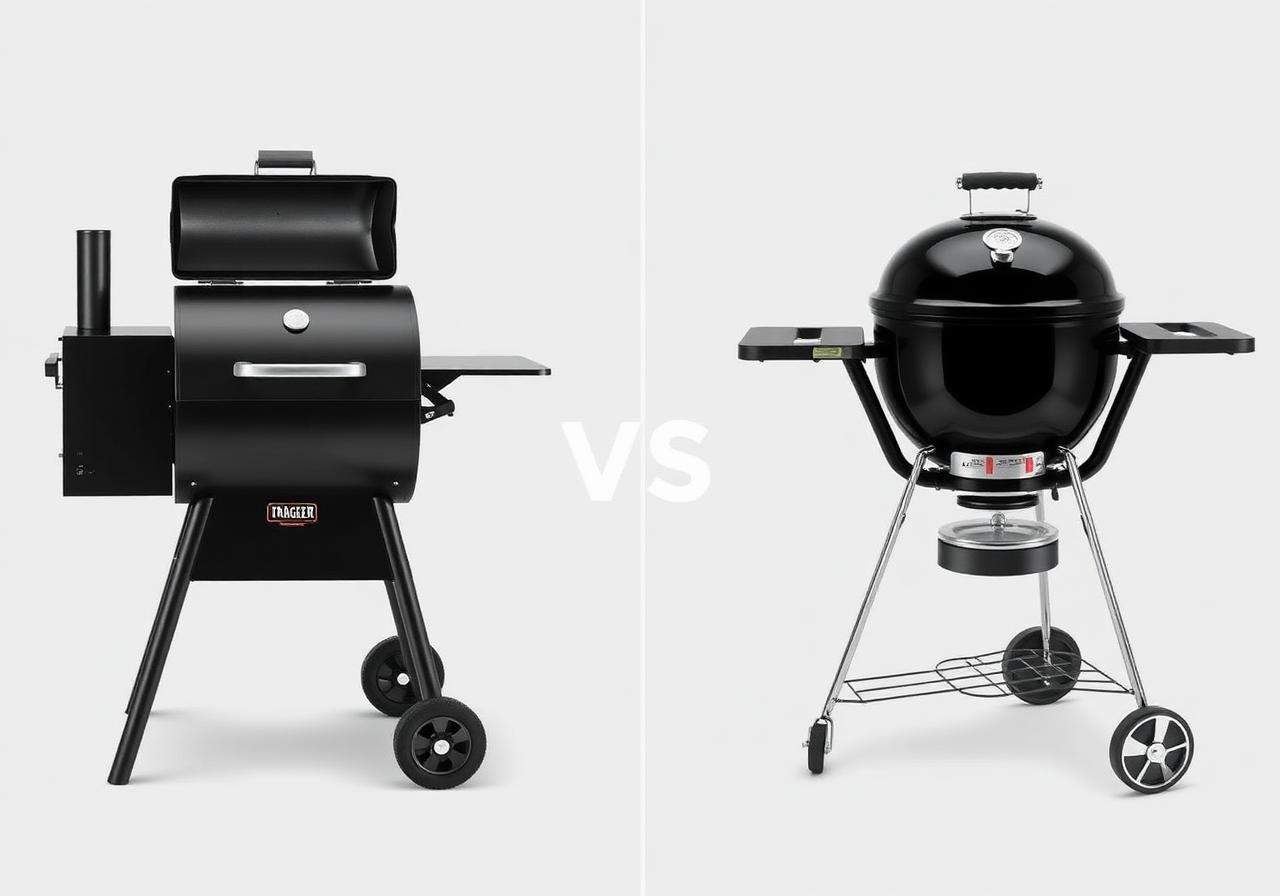
Traeger Westwood pellet grill next to Weber Performer Smart charcoal kettle grill on a clean background

$699 pellet smart vs $599 charcoal smart. Same price tier, opposite cooking philosophies.

TL;DR

The 30-Second Answer

Buy the Traeger Westwood ($699) if you...

  • Want set-it-and-forget-it convenience for 12+ hour cooks
  • Prioritize the Traeger Connected app and 1,500+ guided recipes
  • Cook 5+ different methods (smoke, bake, roast, grill, dehydrate)
  • Don't want to deal with charcoal mess, ash, or coal management
  • Smoke briskets and pork shoulders 4+ times per year
  • Have indoor power available within 50 feet of grill location

Buy the Weber Performer Smart ($599–$799) if you...

  • Believe charcoal flavor is non-negotiable (this is the entire decision for many)
  • Already love the iconic 22-inch Weber Kettle and want it smarter
  • Want the lowest-cost smart-charcoal entry point ($599 base model)
  • Prefer minimal app dependence — kettle works manually if Wi-Fi fails
  • Have a 70-year warranty path on the kettle (10 years actual)
  • Live in an HOA where pellet smoke isn't permitted (charcoal often is)

These aren't really competitors — they're two completely different cooking philosophies at the same price tier. The Westwood is a pellet smoker with smart features. The Performer Smart is a charcoal grill with smart features. Pellet vs charcoal is the entire conversation; everything else is detail. If you've cooked on both and prefer one, that's your answer. If you've never used either, the right question is: do you value convenience (pellet) or flavor (charcoal)?

By the Numbers

Westwood vs Performer Smart: Side-by-Side Specs

SpecTraeger WestwoodWeber Performer Smart
Price (Base)$699.99$599 (base Smart); $799 (Premium Smart)
Fuel TypeHardwood pellets (continuous)Charcoal briquettes or lump
Cooking MethodConvection (indirect heat dominant)Direct flame + radiant heat
Cooking Area653 sq in (dual-tier)363 sq in (single-tier 22-inch kettle)
Temperature Range180–450°F180–600°F
Max Temp450°F600°F (decisive for searing)
Smart ControlYes — WiFIRE appYes — Weber Connect app
Wi-Fi Connectivity2.4GHz Wi-Fi + Bluetooth2.4GHz Wi-Fi + Bluetooth
Probes Included1 wired + wireless option (+$80)1 included + 2 probe ports
Continuous Fuel Capacity18-lb hopper (~12+ hours of fuel)1 charcoal load (4–8 hours; reload required for longer)
Setup Time per Cook~10 min preheat~15–20 min coal lighting (Rapidfire Assist)
Cook Time per Brisket (12 lb)12–14 hours, no reload12–14 hours, may need 1 coal top-off
Power RequiredYes — must stay plugged inYes — must stay plugged in (including cool-down)
Off-Grid CapableNo (continuous power required)Limited — runs 5–6 hours on phone power bank
Smoke ProfileMild to moderate (pellet smoke)Strong (real wood smoke + charcoal flavor)
Sear CapabilityLimited (450°F max, fan-driven)Strong (600°F + direct flame coals)
CleanupManual scrape/vacuum (no EZ-Clean keg)Manual ash sweep into ash catcher (One-Touch system)
Recipe App Library1,500+ guided recipesWeber Connect app + Weber.com recipe library
Footprint~25 × 41 inches~48 × 25 inches (with cart)
Weight~130 lbs assembled~91 lbs assembled
Assembly Time~60 min, two-person~4–5 hours, two-person (per Weber.ca early reviewers)
Warranty (Body/Kettle)3-year limited10 years on kettle
Warranty (Electronics)3-year limited3 years on electronics
Apartment FriendlyNo (size + weight)Better (smaller footprint; HOA charcoal rules vary)
AvailableCurrently shippingSpring 2026 base; Summer 2026 premium

The honest reading: these are different cooking machines for different buyers. Westwood is a hands-off pellet smoker that prioritizes convenience and recipe automation. Performer Smart is a hands-on charcoal grill that prioritizes flavor and direct-flame searing. The smart features are similar; the underlying cooking philosophy is opposite.

Head-to-Head

7 Categories That Decide the Buyer

1. Smoke Flavor and Cooking Output

Winner: Weber Performer Smart

Charcoal produces materially stronger smoke flavor than pellets — this is the entire reason charcoal cooks insist on charcoal. The Westwood's pellet smoke is mild to moderate; AmazingRibs.com testing confirms pellet grills produce 30–50% less smoke ring depth than charcoal at the same protein and time. For brisket, ribs, and pulled pork where smoke flavor is the defining quality, the Performer Smart wins. The Westwood's flavor is good — but it's pellet-grill good, not charcoal good.

2. Hands-Off Convenience

Winner: Traeger Westwood (decisive)

The Westwood's 18-lb hopper holds 12+ hours of continuous fuel. Set 225°F, walk away for the entire brisket cook, get app alerts when done. The Performer Smart can hold 225°F for 8+ hours but requires monitoring for coal management on cooks longer than 6 hours — you may need to add coals at the halfway point of a brisket. For owners who want true set-and-forget overnight cooking, the Westwood is the only option here.

3. High-Heat Searing

Winner: Weber Performer Smart (decisive)

The Performer Smart hits 600°F and uses direct flame on coals; the Westwood maxes at 450°F via convection. For burgers, steaks, scallops, fish — anything where you want sear marks and Maillard browning — the Performer Smart genuinely sears. The Westwood with the ModiFIRE Sear Grate ($60 add-on) reaches sear-quality contact heat but still lacks direct flame. If you sear regularly, the Performer Smart wins this category by 2 cooking generations.

4. Cooking Area and Capacity

Winner: Traeger Westwood

The Westwood's 653 sq in dual-tier configuration beats the Performer Smart's 363 sq in single-tier kettle by 80%. For households of 6+ or anyone batch-smoking multiple primals (2 briskets, 4 pork shoulders), the Westwood is essential. The Performer Smart's 22-inch kettle is sized for 4–6 servings at most. Households of 2–4 are fine with either.

5. Recipe and App Ecosystem

Winner: Traeger Westwood

Traeger's app library has 1,500+ guided recipes with step-by-step temperature/probe instructions — pellet grilling has built recipes-as-software for over 5 years. Weber Connect app is competent but more limited; Weber.com hosts ~300 recipes. For owners who actually use guided recipes (most do for their first 6 months), the Westwood's app advantage is real. After year 1, owners typically rely on their own technique regardless of brand.

6. Cleanup and Maintenance

Winner: Traeger Westwood (with caveat)

The Westwood lacks the EZ-Clean grease and ash keg that Woodridge owners praise — cleanup on the Westwood is the older Traeger process (manual scraping, vacuum, dispose). The Performer Smart uses Weber's One-Touch ash system: rotate the handle, sweep ash through the bottom into the ash catcher, dump. Both are similar in effort per cook (~5–10 min). Edge to Westwood because pellet ash is significantly less than charcoal ash by volume — less mess overall, even with a less-elegant cleanup mechanism.

7. Long-Term Reliability and Resale

Winner: Weber Performer Smart

The Weber Kettle has been in production since 1952 with proven 20–30 year reliability records. The 10-year kettle warranty is exceptional. The Performer Smart's electronics are new; their long-term reliability is unproven, but the kettle itself is a known-good product. The Westwood is 3 weeks old at the time of this review — long-term data doesn't exist. Traeger is also in financial restructuring per Engadget; Weber is not. For 10+ year ownership horizon, the Performer Smart is the safer purchase.

The Fuel Question

Pellet vs Charcoal: Which Do YOU Actually Want?

Spec sheets aside, the Traeger Westwood vs Weber Performer Smart decision is really a pellet-vs-charcoal decision. These are two different cooking philosophies that produce different food. After ~3 weeks of cooking on each, food enthusiasts can tell the difference; casual cooks often can't.

Pellets win on convenience. Set a temperature, the grill maintains it for 12+ hours without intervention, and the pellets produce mild-to-moderate smoke that flavors food evenly. The Traeger app guides you through cooks. You're cooking with a smart appliance that happens to use wood for flavor.

Charcoal wins on flavor. Real charcoal smoke is denser, more complex, and produces deeper smoke rings. The Performer Smart's digital fan and Wi-Fi controller solve charcoal's traditional weakness (temperature management) without changing the fuel. You're cooking with charcoal that happens to be Wi-Fi controlled.

Which is right depends on what you value. Pellet enthusiasts on r/Traeger consistently say the convenience trade is worth it; charcoal enthusiasts on r/charcoalgrilling consistently say no amount of convenience justifies the flavor downgrade. Both camps are correct from their own perspective. The honest question for you: have you ever cooked on charcoal and thought "I wish this was easier"? Or have you ever cooked on a pellet smoker and thought "this needs more smoke"? Whichever question you've asked points to the right purchase.

Reframe

The Wrong Question: "Which Smart Grill Is Better?"

The honest answer to "is the Traeger Westwood better than the Weber Performer Smart?" is: they're not comparable in the traditional sense. They're solving different problems for different buyers using different fuels and different cooking philosophies. Asking "which is better" is like asking "is a sedan better than a pickup?" — depends entirely on what you need.

The right question is: what kind of cooking do I do, and what fuel matches that cooking? If you smoke briskets and cook for crowds, the Westwood's hands-off operation and 653 sq in are decisive. If you sear steaks and value charcoal flavor, the Performer Smart's 600°F max and real-coal cooking are decisive. If your cooking is 50/50 grilling and smoking, you'd actually want both — the Westwood for smoke days, the Performer Smart for grill days.

The trap is buying the Westwood because pellet grilling is "modern" and discovering you miss charcoal flavor — or buying the Performer Smart because charcoal is "authentic" and discovering you don't want to manage coals every weekend. The answer is in your cooking history, not in spec comparisons. If you've genuinely never cared about charcoal flavor, the Westwood is the smart buy. If you genuinely won't compromise on charcoal flavor, the Performer Smart is the smart buy. Buying based on prestige or "better" specs leads to regret in 6 months.

Which One Fits Your Cooking

Cooking Scenarios — Better Choice

Cooking ScenarioBetter ChoiceWhy
Weeknight burgers and chicken for 4Performer SmartFaster preheat, real sear marks, less appliance feel
Weekend brisket smoke for 8 peopleWestwoodHands-off operation; 653 sq in fits 1–2 briskets + sides
Searing steaks weeklyPerformer Smart (decisive)600°F + direct flame is real searing; 450°F is not
Set-and-forget overnight cookingWestwood (decisive)Westwood holds set temp for 12+ hours unmonitored
Pizza on a stonePerformer Smart600°F is required for pizza; Westwood at 450°F undercooks crust
Apartment balcony or HOA-restrictedPerformer SmartSmaller footprint; HOAs often allow charcoal but ban pellet smoke
First-time buyers learning to smokeWestwoodRecipe app guides you through technique; charcoal has steeper learning curve
Cooks who already love their old Weber KettlePerformer SmartOr get the $280 Smart Ring retrofit for the kettle they already own
Cooks who hate babysitting firesWestwoodPellet auto-feed eliminates fire management entirely
Hosting BBQ parties for 10+ peopleWestwood XL or WoodridgeBoth base options are too small for this scale

Real Ownership Costs

What Each Grill Actually Costs Over 3 Years

Sticker price isn't the only cost. Pellets, charcoal, accessories, and maintenance add up over years. Here's the projected 3-year cost-of-ownership for each grill assuming moderate use (40 cooks per year).

Cost ItemTraeger WestwoodWeber Performer Smart
Initial Purchase$699$599 (base) or $799 (premium)
Year 1 Pellets/Charcoal$300 (15 × 20-lb pellet bags)$180 (15 × 20-lb charcoal bags)
Year 1 Cover$80$60
Year 1 Wireless Probe$80 (essential addition)$0 (1 included + 2 ports)
Year 1 ModiFIRE Sear Grate$60 (recommended)$0 (charcoal sears natively)
Year 1 Subtotal$1,219$839 base / $1,039 premium
Year 2 Pellets/Charcoal$300$180
Year 2 Replacement Liners/Consumables$50$30
Year 2 Subtotal$350$210
Year 3 Pellets/Charcoal$300$180
Year 3 Replacement Cover$80$60
Year 3 Subtotal$380$240
3-Year Total~$1,949~$1,289 base / $1,489 premium

Charcoal is meaningfully cheaper than pellets long-term — about $120 less per year in fuel costs alone. Over 3 years, the Performer Smart costs $660 less than the Westwood at the base tier, even after accounting for the Westwood's lower sticker price advantage. For owners cooking heavily, the fuel-cost gap widens further. This isn't a reason to choose charcoal over pellets — fuel preference should drive the decision — but it's a meaningful consideration most spec sheets ignore.

FAQ

Frequently Asked Questions

Is the Traeger Westwood or Weber Performer Smart better for beginners?
For beginners with no smoking experience, the Westwood is the more forgiving learning platform. The Traeger Connected app has 1,500+ guided recipes with step-by-step instructions, and pellet auto-feed eliminates fire management. Charcoal cooking has a steeper learning curve — managing coals, controlling vents, recovering from temp drops. After 6 months of practice, charcoal becomes second nature; for the first 6 months, pellet grilling is materially easier.
Can the Weber Performer Smart smoke as well as the Traeger Westwood?
Yes — and arguably better in flavor. Real charcoal produces stronger, more complex smoke than pellets. The Performer Smart's digital fan holds 225°F for 8+ hours of low-and-slow without owner intervention, comparable to pellet grilling's hands-off operation. The Westwood holds set temp longer (12+ hours per hopper load vs ~8 hours per coal load), so for very long brisket cooks the Westwood requires less monitoring. For flavor, the Performer Smart wins; for convenience, the Westwood wins.
Why is the Performer Smart cheaper than the Westwood?
Two reasons. (1) Charcoal grill manufacturing is mature — the Weber Kettle has been in production since 1952, with all R&D and tooling costs amortized. Pellet grills are newer technology with higher manufacturing costs. (2) Pellet grills include the auger motor, hopper, controller, and fan as factory-integrated components; charcoal grills add smart features as a controller-and-fan retrofit on a kettle. Different cost structures, similar end functionality.
Which one has better smart app integration?
Both are competent; Traeger Connected is slightly more polished. Traeger has 5+ years of head start on connected pellet grilling, with deep recipe libraries and tested probe integration. Weber Connect is newer (the Performer Smart is Weber's first major Wi-Fi charcoal launch) but feature-equivalent for core functions. Both apps support: temperature setting, probe alerts, scheduled cooks, recipe walkthroughs, and remote monitoring. Daily app experience is similar; recipe library size favors Traeger.
Can the Westwood sear like the Performer Smart can?
Not natively. The Westwood maxes at 450°F via convection — the Performer Smart hits 600°F with direct flame on coals. For real sears (Maillard browning, defined sear marks), the Performer Smart wins. The Westwood with the ModiFIRE Sear Grate ($60 add-on) gets close — the aluminum grate concentrates heat to ~500–550°F at the cooking surface — but still lacks the direct flame component that makes charcoal sear distinctively.
Which fits better in a smaller backyard or balcony?
The Performer Smart by a small margin. Both grills are similar in cart size, but the Performer Smart's kettle-on-cart configuration is easier to roll across patios and store under cover. The Westwood's larger barrel and hopper add bulk. For HOA-restricted apartments, charcoal grills are sometimes permitted where pellet grills aren't (less smoke output) — verify your specific HOA rules before assuming either is allowed.
What about the Weber Smart Wireless Probe — does it work with the Westwood?
No. Weber's Smart Wireless Probes are built for the Weber Connect app, which doesn't communicate with the Traeger Connected app. Traeger has its own Wireless Meat Probe (powered by MEATER) that pairs with Traeger Connected. The probes aren't cross-compatible; if you switch grill brands, you'd buy the matching probe ecosystem.
Should I buy a Westwood or wait for the Weber Performer Premium Smart at $799?
Different decision criteria. The Performer Premium Smart at $799 is the same Performer Smart kettle with a larger storage shelf and side table — it's a cart upgrade, not a cooking upgrade. The base Performer Smart at $599 cooks identically to the Premium Smart. Compare the Westwood at $699 to the BASE Performer Smart at $599 ($100 cheaper) — that's the more honest cross-cluster comparison. The Premium Smart adds $200 of cart features that don't affect cooking quality.