Head-to-Head Comparison

Traeger Westwood vs Westwood XL: Is the $100 Bigger Worth It?

The Traeger Westwood ($699) and Westwood XL ($799) are the same grill in two sizes — same 18-lb hopper, same WiFIRE controller, same dual-tier cooking, same P.A.L. rail system, same 3-year warranty. The only meaningful difference is cooking area: 653 sq in on the standard versus 823 sq in on the XL. After cross-referencing Traeger's official capacity numbers (the XL fits 28 chicken breasts, 7 rib racks, or 25 burgers simultaneously), reporting from Gear Patrol and GearJunkie, and the honest math on what 170 extra sq in actually costs you, here's the verdict on whether the XL is worth the $100 — or whether the standard Westwood is the better buy for your cooking.

8 min read Updated May 2026 Independently researched
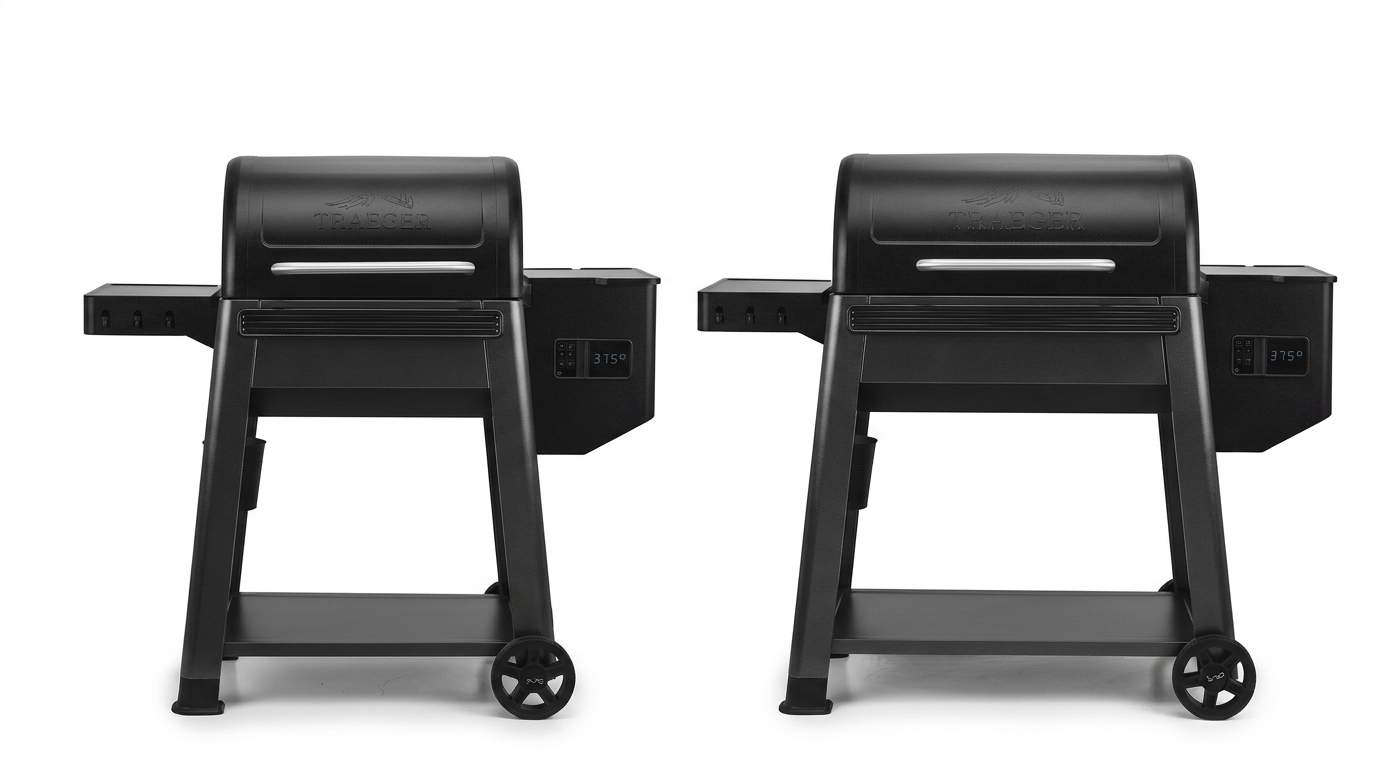
Traeger Westwood and Westwood XL pellet grills side by side on a wood deck showing the size difference

Same grill, two sizes. The only meaningful difference is 170 sq in of cooking area.

TL;DR

The 30-Second Answer

Buy the Westwood (Standard) if you...

  • Cook for 1–6 people regularly
  • Have a smaller backyard, deck, or patio
  • Smoke 2–4 times per month (one brisket or one pork shoulder per cook)
  • Want to spend $699 instead of $799 — the savings buy 4–5 bags of pellets
  • Don't host more than 8 people at a time

Buy the Westwood XL if you...

  • Cook for 6+ people most weekends
  • Batch-smoke (2 briskets simultaneously, or 4 pork shoulders for the freezer)
  • Host backyard parties of 10+ people
  • Already know you outgrew your last pellet grill on size, not features
  • Plan to compete in BBQ contests or sell BBQ at events

The XL adds 170 sq in for $100 — that's $0.59 per square inch of cooking space, which is excellent value if you'll actually use the space. If your typical cook fills less than 80% of a 653 sq in surface, you don't need the XL — the standard Westwood saves you $100 you can spend on pellets, accessories, or meat instead.

By the Numbers

Westwood vs Westwood XL: Side-by-Side Specs

SpecWestwood (Standard)Westwood XL
Price (MSRP)$699.99$799.99
Total Cooking Area653 sq in823 sq in (+26%)
Pellet Hopper Capacity18 lbs18 lbs
Temperature Range180–450°F180–450°F
ControllerSame digital button-basedSame digital button-based
WiFIRE Wi-Fi + BluetoothYesYes
Wired Probe Ports11
Wireless Probe CompatibleYes (+$80 sold separately)Yes (+$80 sold separately)
P.A.L. Pop-and-Lock RailYesYes
ModiFIRE CompatibilityYesYes
Side ShelfBuilt-inBuilt-in
Bottom Storage ShelfYesYes
Dual-Tier CookingYesYes
Warranty3-year limited3-year limited
Assembly Time~60 min, two-person~70–80 min, two-person (heavier)
AvailableCurrently shippingCurrently shipping

Notice what's identical: hopper, controller, Wi-Fi, probe spec, accessories, warranty, temperature range. The XL is not a "better" grill — it's a bigger grill. Anyone telling you the XL has features the standard doesn't is misreading Traeger's own spec sheet.

Real Capacity

What Does 170 Extra Square Inches Actually Cook?

Cooking-area numbers feel abstract until you map them to real food. Here's what each Westwood actually fits, based on Traeger's published capacity numbers and proportional math for the standard model.

FoodWestwood (653 sq in)Westwood XL (823 sq in)
Chicken breasts~2228
Burger patties (4-inch)~1925
Pork rib racks (full)~57
Whole chickens (5-lb each)34
Pork shoulders (8-lb each)23
Briskets (12-lb each, packer cut)12
Pizza (12-inch)2 simultaneously3 simultaneously
Rib racks + 2 sidesYes (tight fit)Yes (comfortable)
Thanksgiving turkey (15-lb) + sidesTight — likely two batchesSingle batch with room to spare

The standard Westwood handles every weeknight cook and most weekend BBQs comfortably. The XL becomes essential when you're feeding 8+ people regularly or batch-smoking multiple primals. If you've never run out of grill space on your current setup, you don't need the XL.

Real Use Cases

5 Cooking Scenarios Where the XL Earns Its $100

1. You smoke for the freezer.

Pulled pork freezes excellently, but a single 8-lb shoulder yields ~6 lbs of pulled meat — about 12 servings. If you batch-smoke 4 shoulders at once (XL handles, standard doesn't), you've stocked the freezer for 3 months in one cook. The math: $100 XL premium amortized over 3 months of meat = $33/month, which is less than the time-and-pellet cost of running 4 separate cooks.

2. You host BBQ parties of 10+ people.

A full rack of ribs serves 3–4 people. For 12 guests, you need 3 full racks plus sides. The standard Westwood fits 5 rib racks but not also vegetables and sides; the XL fits 7 racks plus full side dishes simultaneously.

3. You cook competition or sell BBQ at events.

Most KCBS and similar competitions require 4 separate proteins (chicken, ribs, pork, brisket). Running these on a 653 sq in surface requires multiple sequential cooks. The XL's 823 sq in fits all 4 simultaneously with proper indirect-heat zones.

4. You meal-prep a week of dinners in one cook.

28 chicken breasts on the XL = 4 weeks of meal-prep dinners for 2 people, or 2 weeks for a family of 4. The standard Westwood's 22 chicken breasts works but tighter — and gives less headroom for sides.

5. You're the dad/mom who hosts every cookout.

If your house is the de facto Memorial Day, July 4th, and Labor Day venue every year, the XL's headroom prevents the "are we going to have enough?" panic that happens 30 minutes before guests arrive. $100 to never-worry-about-grill-space-again is reasonable insurance.

Real Use Cases (Flip Side)

5 Cooking Scenarios Where the Standard Westwood is Plenty

1. Weeknight family dinners.

4–6 burgers, chicken thighs for 4, salmon fillets for 2, a tri-tip for date night. The standard Westwood's 653 sq in handles every weeknight cooking scenario for households of 1–6 people without crowding.

2. One-protein weekend BBQ.

Smoking a single brisket or 2 racks of ribs for 6 guests doesn't need 823 sq in. The standard Westwood fits exactly this scenario with room for a vegetable tray.

3. Apartment patios or small decks.

The XL's larger footprint (~6 inches wider, ~4 inches deeper) matters when patio space is tight. The standard Westwood fits comfortably on 3' × 4' deck spaces; the XL needs 4' × 5' minimum.

4. First-time pellet grill buyers.

If you've never owned a pellet grill, you don't yet know whether your cooking style will use 823 sq in regularly. Buy the standard, learn the platform, and upgrade in 3–5 years if you find yourself outgrowing it. Selling a used Westwood standard recovers ~$400–500; the depreciation cost is roughly the same as paying for the XL upfront.

5. You smoke once a month or less.

If smoking is occasional rather than weekly, you'll never use the XL's headroom. Save the $100 for pellets, a wireless probe ($80), or a cast-iron sear grate accessory.

What the Spec Sheet Doesn't Show

Trade-offs of the Westwood XL

The XL costs $100 more for cooking-area, but it costs other things too. First, assembly is harder. The XL ships in a heavier carton (~155 lbs vs ~130 lbs for the standard) and the larger barrel is awkward to position single-handedly. Plan 70–80 minutes for two-person assembly vs ~60 minutes on the standard.

Second, fuel efficiency is worse. The XL's larger cooking chamber means more interior volume to heat — that translates to roughly 15–20% more pellet consumption per cook at the same temperature. A bag of Traeger pellets that lasts 18 hours on the standard Westwood lasts ~15 hours on the XL.

Third, the pellet hopper is the same size on both. This is the underrated XL drawback. With an 18-lb hopper but higher pellet consumption, the XL needs hopper refills slightly more often — which is fine for shorter cooks but matters for 12+ hour brisket sessions where the standard might finish on a single hopper load and the XL might need a top-off.

Fourth, the footprint is meaningfully larger. The XL is wider, deeper, and heavier — harder to roll across patio steps, harder to fit through narrow gates, and harder to store in a covered area. Measure your space before assuming the XL fits where the standard would.
Reframe

The Wrong Question: "Is the XL Better Than the Standard?"

The honest answer to "is the Westwood XL better than the standard Westwood?" is: they're the same grill. The XL has more cooking area; that's the entire feature delta. Asking "is XL better" is like asking "is a 36-inch TV better than a 32-inch TV?" — same TV, different screen size, your room dimensions decide which one is right.

The right question is: how often do I run out of cooking space, and how often do I host more than 6 people? If the answer to either is "frequently," the XL is the right buy. If the answer to both is "rarely," the standard is the right buy and you should put the $100 toward pellets, a wireless probe, or a Bear Mountain bulk-pellets order.

The trap is buying the XL because it's the "better" option and discovering 6 months in that you've never filled more than half the cooking surface. At that point you've paid $100 for headroom you don't use — and the XL's larger footprint, assembly burden, and pellet appetite are all costs you're paying for nothing.

FAQ

Frequently Asked Questions

What's actually different between Westwood and Westwood XL?
Only the cooking area: 653 sq in on the standard vs 823 sq in on the XL — a 26% increase for $100. Everything else is identical: same 18-lb hopper, same WiFIRE controller, same temperature range (180–450°F), same single wired probe port, same P.A.L. rail and ModiFIRE accessory compatibility, same 3-year warranty. Anyone telling you the XL has different or upgraded features is misreading Traeger's spec sheet.
Is the Westwood XL worth the $100 extra?
Only if you'll use the space. The math: $100 buys 170 sq in of cooking area, or roughly $0.59 per square inch. If you regularly cook for 6+ people, batch-smoke multiple primals, or host larger gatherings, the XL pays for itself in convenience within the first 3–5 cooks. If your typical use case is 1–6 people and one protein at a time, the standard Westwood is plenty.
Does the Westwood XL have a bigger pellet hopper?
No. Both Westwood and Westwood XL use the same 18-lb hopper. This is the XL's most underrated drawback — the larger cooking chamber consumes pellets ~15–20% faster per cook at the same temperature, but the hopper isn't bigger to compensate. For 12+ hour brisket cooks, the XL may need a hopper top-off where the standard could finish on a single load.
Does the Westwood XL cook differently than the standard?
No — same temperature range (180–450°F), same convection airflow, same dual-tier configuration. The XL produces identical food quality to the standard at any given temperature. It just produces more of it. Cook times are unchanged on a per-protein basis; the only difference is how much you can cook simultaneously.
What's the size difference in physical dimensions?
The XL is approximately 6 inches wider and 4 inches deeper than the standard Westwood. Total footprint: standard fits comfortably on a 3' × 4' deck space; XL needs roughly 4' × 5'. Weight: standard ~130 lbs assembled, XL ~155 lbs assembled. Measure your patio or deck space before assuming the XL fits where the standard would.
Can I upgrade from a Westwood to a Westwood XL later?
Not directly — the cooking chambers aren't interchangeable. If you outgrow the standard, you'd sell it (used Westwoods recover ~$400–500 in the first 3 years) and buy a new XL. The depreciation cost is roughly equivalent to paying the XL premium upfront, so the 'buy small first, upgrade later' strategy doesn't save money — it just delays the $100. The right question is whether you'll need the size NOW or never.
How does the Westwood XL compare to the Pro 780?
The Pro 780 (now being phased out) has 780 sq in vs the Westwood XL's 823 sq in — slightly less cooking area on the Pro 780. But the Pro 780 includes 2 wired probe ports (vs Westwood XL's 1) and Keep Warm mode (which the Westwood lacks). If you can find a Pro 780 closeout under $700, it's a real alternative to the XL. At full retail, the Westwood XL's newer controller and P.A.L. accessory system make it the better buy.
Is the Westwood XL a good first pellet grill?
For most first-timers, no. New pellet-grill owners typically don't yet know how their cooking style will scale, and 823 sq in is more space than most weeknight cooks fill. Buy the standard Westwood first, learn the platform, and upgrade if you find yourself routinely running out of cooking space. The exception: if you already know you cook for 8+ people regularly (large family, frequent host), buying the XL upfront avoids the 'wish I'd gone bigger' regret that 1 in 3 standard-Westwood owners report on Traeger Forum.